 Sergio Armaroli











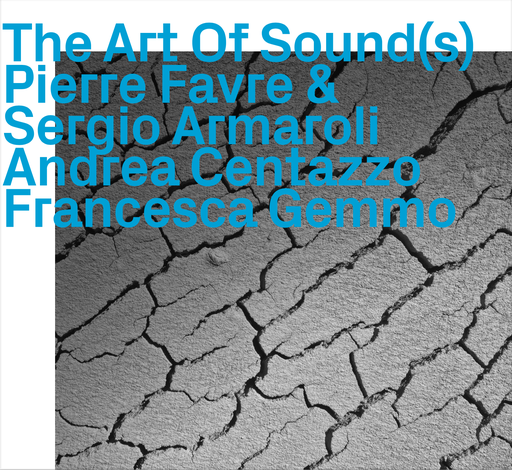
THE ART OF SOUND(S)
PIERRE FAVRE &
SERGIO ARMAROLI
ANDREA CENTAZZO
FRANCESCA GEMMO
About this album
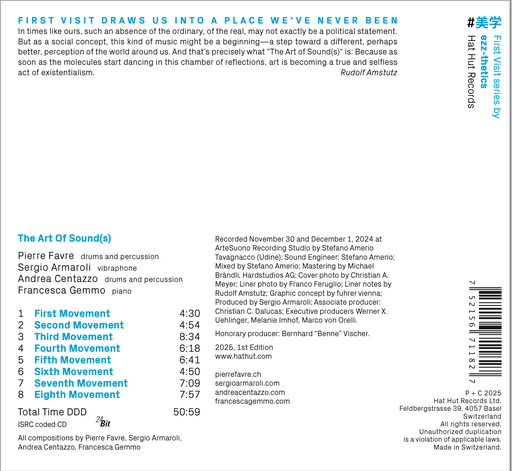
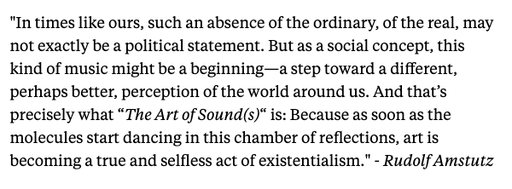
In times like ours, such an absence of the ordinary, of the real, may not exactly be a political statement. But as a social concept, this kind of music might be a beginning—a step toward a different, perhaps better, perception of the world around us. And that’s precisely what “The Art of Sound(s)“ is: Because as soon as the molecules start dancing in this chamber of reflections, art is becoming a true and selfless act of existentialism.
(Rudolf Amstutz)
Program
1. First Movement 4:30
2. Second Movement 4:54
3. Third Movement 8:34
4. Fourth Movement 6:18
5. Fifth Movement 6:41
6. Sixth Movement 4:50
7. Seventh Movement 7:09
8. Eighth Movement 7:57
Serie
First Visit 50th Anniversary Series
Barcode
752156711827
Released
August 15, 2025





REVIEWS
It would not be prudent to overlook history when considering the music created by the improvising artists of The Art of Sound(s). As William Shakespeare wrote in The Tempest: "By that destiny to perform an act / Whereof what's past is prologue, what to come in yours and my discharge." In other words, this 2024 recording could not exist without the accumulated experiences and creative legacies of its four musicians.
At the center stands Swiss drummer Pierre Favre, a veteran of jazz and improvised music whose journey mirrors that of many European pioneers. Like Peter Brötzmann, Favre began in Early Jazz before embracing free improvisation, working with figures such as Peter Kowald, Irene Schweizer, Paul Motian, Albert Mangelsdorff and Joe McPhee. His exploration of percussion as a language rather than a mere timekeeping device profoundly influenced Italian drummer Andrea Centazzo, who became both collaborator and disciple. The two performed and recorded together extensively, with Favre's mentorship helping shape Centazzo's expansive musical vision.
Centazzo, in turn, became a key figure in the New York Downtown scene, recording with Steve Lacy, Derek Bailey, Lol Coxhill and John Zorn, and founding the groundbreaking Ictus Records label. He later mentored Italian percussionist and vibraphonist Sergio Armaroli, a versatile artist equally at home in avant-garde and chamber settings. Armaroli's creative partnership with pianist Francesca Gemmo—both interpreters of John Cage's musical philosophy—brings an additional layer of conceptual depth to this project.
In that sense, this recording feels not accidental but inevitable—a convergence of generations linked by curiosity, mentorship and a shared pursuit of sonic truth.
The album's eight improvised tracks, divided into "Movements," unfold with organic precision. Each one feels both spontaneous and deliberate, oscillating between chamber-like restraint and the wild freedom of improvisation. The quartet blends classical poise with minimalist abstraction, as though reciting poetry in a language that is simultaneously familiar and strange.
Gemmo reminds us that the piano is, at its core, a percussion instrument—her hammers echoing the mallets of Armaroli's vibraphone. Both musicians blur the boundary between rhythm and harmony, while Favre and Centazzo extend the very notion of what percussion can be: color, space, resonance and breath. Together, the four create a sound world where pulse dissolves into texture, and texture becomes time.
The Art of Sound(s) is more than a meeting—it is a dialogue across generations, a living testament to how musical lineage and invention continually reshape each other. What's past is indeed prologue, and in this music, the future speaks fluently through the echoes of history.

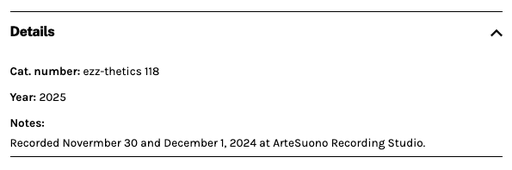

The Art of Sound(s) ist ein Musikalbum von Pierre Favre, Sergio Armaroli, Andrea Centazzo und Francesca Gemmo. Die am 30. November und 1. Dezember 2024 im ArteSuono Recording Studio Tavagnacco (Udine) entstandenen Aufnahmen erschienen am 31. Oktober 2025 auf ezz-thetics in der Reihe First Visit.



March 2, 2026
The Art of Sound(s)
Hat hut ezz-thetics 118
Equivalent to a PhD dissertation in percussion methodology, these sessions shape idiophone paradigms in distinctive manners. Unwilling to emphasize percussion textures above all else, the appropriately titled The Art of Sound(s) stretches its parameters with an eight-movement suite performed by four veteran improvisers, Swiss drummer/percussionist Pierre Favre and three Italians: pianist Francesca Gemmo, vibraphonist Sergio Armaroli and drummer/percussionist Andrea Centazzo.
A stricter situation, The Art of Sound(s) is as expressive, but more formal creation, possibly because the quartet members are involved in notated as well as extemporaneous musical situations. Favre has a long history in creative music with everyone from Irène Schweizer to Samuel Blaser. Armaroli has worked with the likes of Roger Turner and Evan Parker. Centazzo is known for leading the pioneering Mitteleuropa Orchestra and Gemmo has worked with Alvin Curran.
Divided into overlapping movements, piano comping, vibe reverb and mid-range percussion ruffs and bass drum echoes occupy the four until a stop-time expression with ascending marimba-like pops first defines the theme on “Second Movement”. From then on sounds intensify. The pianist turns from comping to a designated processional line as metal bar plinks and tinkles from the vibist color the narrative as it unrolls and ascends backed by cymbal crashes and bass drum vibrations.
Soon all four are operating at elevating intensity with energetic, two-handed piano pulses especially notable. Armaroli and Gemmo lobby the exposition between them undeterred by pressurized drum paradiddles until Favre and Centazzo shuffle an underlying leitmotif which resembles an authoritative military march on “Sixth Movement”. The pivot to 19th Century-like Russian romantic contours from Gemmo, reintroduces precision from what could have reached a polyphonic outpouring. Light shading including cymbal clacks, drum pitter patter, isolated vibe resonation and single piano notes changes the narrative’s architecture. Eventually keyboard patterns and vibraphone reverb unite into a multi-colored and descending stop-time finale.
In the right hands multiple percussion with the right motivations and in the right combinations can produce all the sonic colors needed for a memorable creation. Aided by non-idiophones, both sessions here demonstrate that axiom.
–Ken Waxman