 Sergio Armaroli











PEDAGOGICA
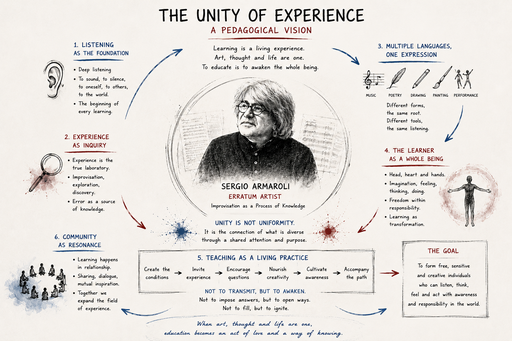
The Unity of Experience: A Pedagogical Vision
The Unity of Experience is the foundation of Sergio Armaroli’s pedagogical practice.
Learning is not the accumulation of information but the transformation of experience into understanding. Art, thought, and life are not separate domains; they are interconnected dimensions of a single process of knowledge.
At the center of this approach is listening: listening to sound, silence, oneself, others, and the world. Through listening, observation, improvisation, and reflection, learning becomes an active and creative inquiry into reality.
Music, poetry, drawing, painting, performance, and teaching are understood as different languages of the same experience. Each discipline offers a unique perspective, yet all contribute to the development of awareness, imagination, and understanding.
Education is therefore conceived as a living practice that values curiosity, experimentation, dialogue, and discovery. The role of the teacher is not to transmit fixed knowledge, but to create conditions in which knowledge can emerge through experience.
Inspired by the principle that improvisation is a process of knowledge, this pedagogical vision encourages learners to embrace uncertainty, cultivate attention, and transform questions into opportunities for growth.
The goal is not conformity but the development of free, sensitive, and creative individuals capable of connecting thinking, feeling, and action.
Unity is not uniformity. It is the capacity to connect diverse experiences through attentive listening, creative practice, and shared understanding.
— Sergio Armaroli
Art is a way of knowing.
Percussion and Music Technology
In Sergio Armaroli’s pedagogical approach, Percussion and Music Technology are not separate disciplines but complementary paths within the Unity of Experience.
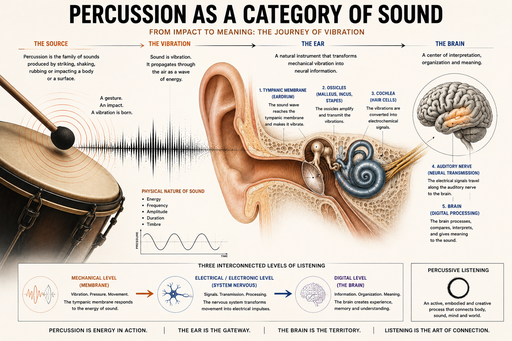
Percussion education develops listening, presence, imagination, and embodied knowledge. Through keyboard percussion, frame drums, improvisation, and ensemble practice, students learn to connect technique with expression, structure with freedom, and sound with meaning.
Music Technology extends this process by offering new ways of listening, exploring, creating, and transforming sound. Technology is understood not as an end in itself, but as a creative environment where curiosity, experimentation, and critical thinking can flourish.
Both fields are grounded in the belief that learning is an active process of discovery. Listening, improvisation, composition, performance, reflection, and collaboration become interconnected dimensions of artistic and personal development.
The goal is to cultivate creative, aware, and independent musicians capable of transforming experience into knowledge and knowledge into artistic action.
Technique is a tool. Listening is the foundation. Creativity is a form of knowledge.
— Sergio Armaroli

The Unity of Experience in Music Technology
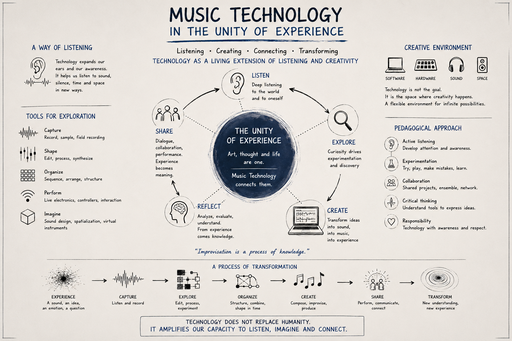
For Sergio Armaroli, Music Technology is not primarily a technical discipline. It is a field of experience, a way of listening, thinking, creating, and understanding the relationships between sound, human action, and the world.
Within the framework of the Unity of Experience, technology is not separated from artistic practice, perception, imagination, or everyday life. Digital tools, electronic media, sound processing, recording systems, interactive environments, and computational processes become extensions of listening and awareness rather than merely instruments of production.
The central question is not what technology can do, but how technology can deepen experience.
Music Technology therefore becomes a laboratory where different dimensions converge:
- listening and analysis
- improvisation and composition
- body and interface
- sound and image
- acoustic and electronic environments
- individual creativity and collective interaction
- artistic practice and critical reflection
Technology expands the possibilities of perception. It allows students and artists to explore sound as material, process, space, memory, and relationship. Recording becomes a form of listening. Editing becomes a form of thinking. Interaction becomes a form of dialogue. Sound design becomes a form of inquiry.
From this perspective, Music Technology is not concerned with mastering tools alone. The deeper objective is the development of a conscious and reflective attitude toward technology itself.
The educational process emphasizes:
Deep Listening
Technology extends the ear.
Students learn to perceive details, relationships, transformations, and hidden dimensions of sound.
Improvisation and Experimentation
Technology becomes an open environment for exploration.
Unexpected results, accidents, and discoveries are welcomed as opportunities for knowledge.
Creativity as Research
Every project is understood as an investigation.
Creating means asking questions, exploring possibilities, and generating new understandings.
Interdisciplinary Thinking
Music Technology connects music, visual arts, poetry, performance, media studies, philosophy, and everyday experience within a common field of inquiry.
Responsibility and Awareness
Technological competence is inseparable from ethical and cultural awareness.
Students are encouraged to reflect critically on the role of technology in contemporary society and artistic practice.
In this sense, Music Technology becomes a contemporary expression of the Unity of Experience: a place where art, knowledge, imagination, and technology meet in a continuous process of transformation.
The goal is not technological expertise alone.
The goal is the formation of creative individuals capable of listening deeply, thinking critically, acting responsibly, and transforming experience into knowledge.
Technology is not the center of the process.
Experience is.
Technology does not replace listening.
It expands the possibilities of listening.
Pubblicazioni: libri, saggi e metodi
Publications: books, essays, and teaching materials
ESECUZIONE ED INTERPRETAZIONE: STRUMENTI A PERCUSSIONE

S.Armaroli - F.Gemmo
STRUMENTI A PERCUSSIONE
Pagg. 148
ISBN 978-88-86349-77-2
Prefazione di Maurizio Ben Omar
"In Italia, lo studio dello strumento nella scuola secondaria di primo grado, risale alla metà degli anni Settanta. Con il DM 06/08/1999 la disciplina Strumento musicale diventa ordinamentale. Questo bel volume è curato dai didatti Sergio Armaroli, percussionista, e Francesca Gemmo, pianista e compositrice. Pubblicato dalla Padus di Cremona, si presenta in elegante veste editoriale: pagine patinate e numerose foto e schemi e colori. Tamburo, tastiere, timpano e batteria: questi gli argomenti di base. Sintesi, razionalità e chiarezza, per il livello richiesto, accompagnano una trattazione esaustiva: storia, costruzione, uso e tecnica; dalle origini alle avanguardie del secondo Novecento. Non mancano esercizi, studietti e brani originali e di repertorio. Il libro, unico per le tre classi, si presenta nella "regolare" versione mista: cartacea con estensione web. Per chi vuole approfondire."
Antonio Galante, Suonare News
ESPERIENZA DENTRO IL SUONO | con la Musica

Autori vari
VIVERE LA MUSICA IN COMUNITA'
Nuova edizione
Pagg.208
ISBN 978-88-86349-75-8
Abstract
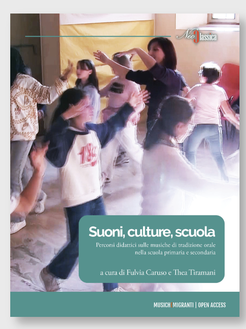
Esiste un patrimonio sonoro vivo e vibrante che viaggia attraverso il tempo e i confini: sono le musiche di tradizione orale. Dai canti narrativi delle nostre regioni ai ritmi complessi delle culture extraeuropee, questo volume offre agli insegnanti della scuola primaria e secondaria una bussola per orientarsi tra la ricchezza dei repertori popolari e la pratica d’aula.
Cosa troverai in questo volume:
Percorsi didattici pronti all’uso: Diciotto unità di apprendimento strutturate per obiettivi e competenze.
Approccio multiculturale: Strumenti per integrare le musiche del mondo nel programma curricolare, promuovendo l’inclusione e il dialogo interculturale.
Dalla teoria alla pratica: Strategie metodologiche per trasformare l’ascolto in partecipazione attiva, attraverso il
corpo, il movimento e l’improvvisazione.
Che si tratti di una filastrocca lombarda o di un rituale ritmico d’oltreoceano, Suoni, culture, scuola non propone solo di “insegnare la musica”, ma di educare alla complessità del mondo
attraverso l’ascolto consapevole dell’Altro.
Un manuale operativo per trasformare la classe in un laboratorio permanente di scoperte sonore.
Gli allegati e i materiali multimediali sono disponibili qui.

SOMMARIO
Introduzione
Perché le musiche del mondo a scuola? – Fulvia Caruso e Thea Tiramani
L’itinerario didattico realizzato – Laura Corona e Claudio Cosi
Articolazione del volume – Fulvia Caruso e Thea Tiramani
I. Utilizzazioni didattiche per le Scuole Primarie
A caccia di suoni e rumori – Grazia Butera e Serena Mainetti
Suoni, gesti e materiali: la voce della musica – Maria Gabriella Peruzzi e Margherita Sacco
Il filo che ci lega: un viaggio nel mosaico culturale degli strumenti a corda – Ilaria De Bona
Le danze tradizionali: un ponte tra generazioni – Silvia Mondani e Catia Sigismondi
Aspettando… l’habanera – Ester Gavinelli e Sara Guida
La voce, il corpo, l’ambiente: vocalità a confronto – Giulia Ferdeghini
La città tra lavoro e memoria: un esempio da Cremona – Barbara Boccelli e Valentina Magda Mariani
La musica delle stagioni – Thea Tiramani
II. Utilizzazioni didattiche per le Scuole Secondarie di Primo e Secondo grado
Il flauto di Pan in Lombardia – Gabriele Vivona
Il bānsurī e la musica indiana – Thea Tiramani
Il trallalero genovese – Alessandra Cella
L’orchestra gamelan a Giava Centrale (Indonesia) – Ilaria Meloni
L’ottava rima improvvisata in Italia centrale – Fulvia Caruso
Un incontro speciale con la musica del Kurdistan – Rosaria Baffa e Sergio Armaroli
Per un festival delle culture del mondo – Riccardo Musio
Le musiche del mondo in un Podcast – Thea Tiramani
