 Sergio Armaroli











THE UNITY OF EXPERIENCE
The UOE Concept
This image was generated using artificial intelligence
Introduction: The Axis Concept
IN SEARCH OF AN AXIS OF BALANCE | AXIS: IN LIFE AND IN PRACTICE
Seeking to live each day within this long-sought Unity (UNITY), I strive to harmonize the many activities and forms through which a single thought manifests itself in life.
A circular movement that I do not interrupt, but continually nourish through openness to experience.
No longer thinking in terms of separation, but of Unity, my practice becomes an experiential whole: an ongoing reflective and operative process of Thinking, Feeling, and Willing, in which different forms and languages enter into dialogue.
Always in search of an axis of balance: AXIS.
This axis lies between languages and styles, forms and instruments—constantly shifting, continually sought and rediscovered—where identity is perpetually renewed and transformed. The axis of balance moves and changes, yet remains true to itself, preserving its continuity within the flow of becoming (Fluxus).
As a maker of signs, I understand language as an active form of knowledge and awareness of Being as World: singular, interconnected, and whole.

This image was generated using artificial intelligence
The Unity of Experience
The Unity of Experience is the central thread running through Sergio Armaroli’s artistic research.
Music, poetry, drawing, performance, teaching, listening, and everyday life are not separate disciplines or autonomous territories. They are different manifestations of the same experience.
Rooted in jazz, improvisation, contemporary art, and experimental thought, this approach rejects rigid categories and stylistic boundaries. Every action becomes part of a continuous process of attention, perception, and transformation. Sound becomes image, image becomes thought, thought becomes gesture, and gesture returns to life.
The work is not directed toward a finished form, but toward a deeper understanding of experience itself. Art is not an object detached from reality; it is a way of inhabiting reality with awareness, openness, and presence.
The Unity of Experience is therefore both an artistic vision and a practice of knowledge: a constant search for connections between things, beyond disciplines, beyond hierarchies, beyond the paralysis of style.

This image was generated using artificial intelligence
The Method
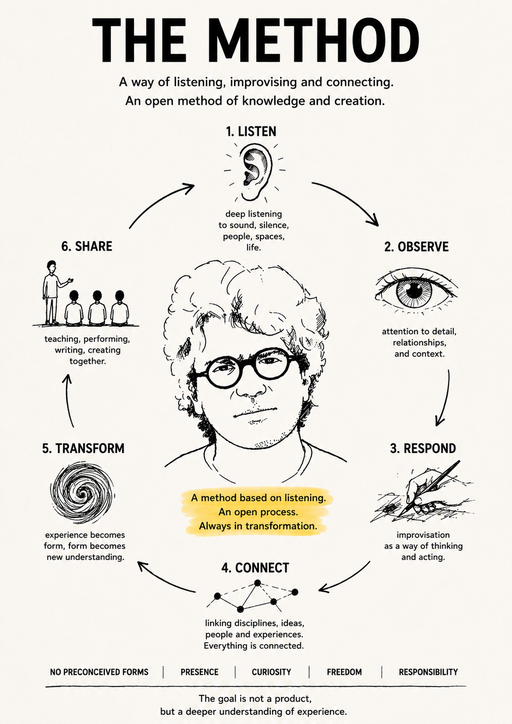
The Method is based on listening.
Listening not only to sound, but to relationships, spaces, silences, movements, words, and everyday events.
Improvisation is understood as a cognitive process: a way of exploring the unknown through attention and action. Rather than applying predetermined forms, the artist develops situations in which perception and experience generate meaning.
The Method privileges process over product, discovery over certainty, and presence over representation.
It is a practice founded on:
- Deep listening
- Improvisation as knowledge
- Interdisciplinary thinking
- Attention to everyday life
- Continuous transformation
- Unity between art and life
In this perspective, artistic work becomes an open field of experience where music, visual art, poetry, education, and human relations contribute to a single evolving process of understanding.
There are no separate territories. There is only one experience, continuously unfolding through different forms.
This image was generated using artificial intelligence
The Method: Between Complexity and Freedom
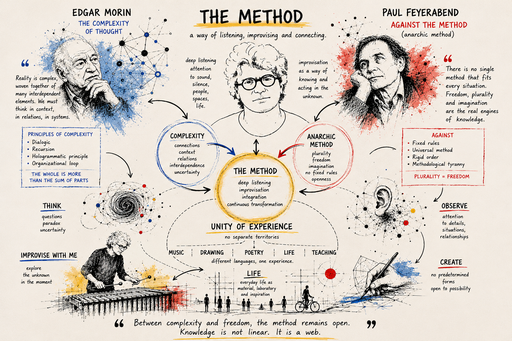
The Method emerges from a dialogue between two fundamental perspectives on knowledge: Edgar Morin's Complexity of Thought and Paul Feyerabend's epistemological anarchism.
From Morin comes the awareness that reality is not composed of isolated elements but of relationships, contexts, interactions, and continuous transformations. Knowledge requires the ability to connect, to embrace uncertainty, and to understand phenomena as part of dynamic systems.
From Feyerabend comes the refusal of rigid methodologies and universal rules. Creativity, discovery, and innovation arise through openness, plurality, imagination, and the freedom to explore unexpected paths. There is no single method capable of explaining or generating every experience.
The Method develops within the productive tension between these two positions. It is neither a closed system nor the absence of structure. Rather, it is an open practice of inquiry based on listening, improvisation, observation, connection, and transformation.
At its center lies the principle of the Unity of Experience: the idea that music, drawing, poetry, teaching, performance, and everyday life are not separate territories but different manifestations of the same experiential process.
Listening becomes the starting point. Improvisation becomes a way of thinking. Complexity becomes a way of understanding relationships. Freedom becomes a condition for discovery.
The Method is therefore a form of knowledge in action: a continuous movement between order and unpredictability, structure and openness, reflection and practice. Its goal is not the production of fixed results, but a deeper understanding of experience and its infinite possibilities.
This image was generated using artificial intelligence
Improvisation As A Process of Knowledge
For Sergio Armaroli, improvisation is not simply a musical practice but a way of knowing.
It is a process through which perception, action, reflection, and discovery unfold simultaneously. Rather than applying predetermined forms or fixed methods, improvisation invites an attentive engagement with what emerges in the present moment.
Rooted in deep listening, improvisation becomes a dynamic dialogue between self, environment, memory, imagination, and experience. It transforms uncertainty into a field of exploration, where new relationships, meanings, and possibilities can be revealed.
Across music, poetry, drawing, painting, and performance, improvisation functions as a cognitive practice: a way of investigating reality through direct experience. Each gesture becomes both an action and a question; each response generates further understanding.
In this perspective, knowledge is not accumulated as a fixed body of information. It is continuously created through interaction, attention, and transformation.
Improvisation is therefore an open method of inquiry—a disciplined freedom that allows thought, perception, and creativity to evolve together.
Key Principles
- Deep Listening
- Presence and Attention
- Openness to the Unexpected
- Improvisation as Inquiry
- Art as a Way of Knowing
- Transformation through Experience
- Unity of Experience
Improvisation is not the absence of structure. It is the practice of discovering structure while living it.
— Sergio Armaroli
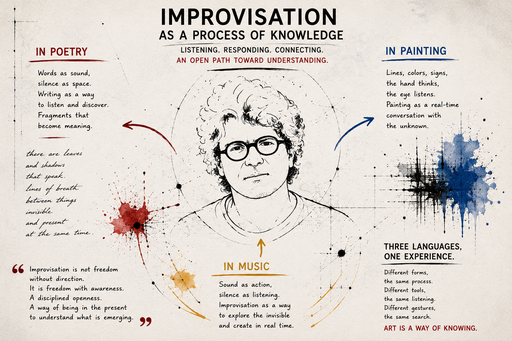
This image was generated using artificial intelligence
At the center of this process lies the idea of Improvisation as a Process of Knowledge and the principle of the Unity of Experience: the conviction that music, poetry, painting, teaching, performance, and everyday life are interconnected forms of the same exploratory journey.
Between Cage’s openness, Russell’s relational thinking, and Hauer’s inner hearing, Armaroli develops an artistic practice that moves freely between structure and freedom, sound and silence, thought and action, seeking to transform experience into understanding and understanding into art.

This image was generated using artificial intelligence
AI Notice
The images and texts on this website have been generated using artificial intelligence, drawing exclusively from original textual and visual materials created by Sergio Armaroli.